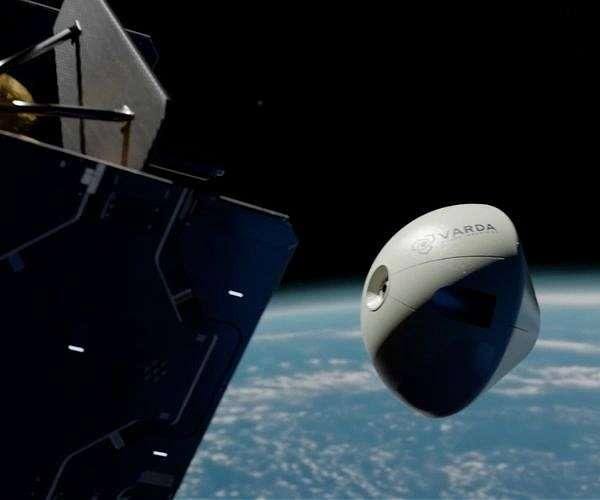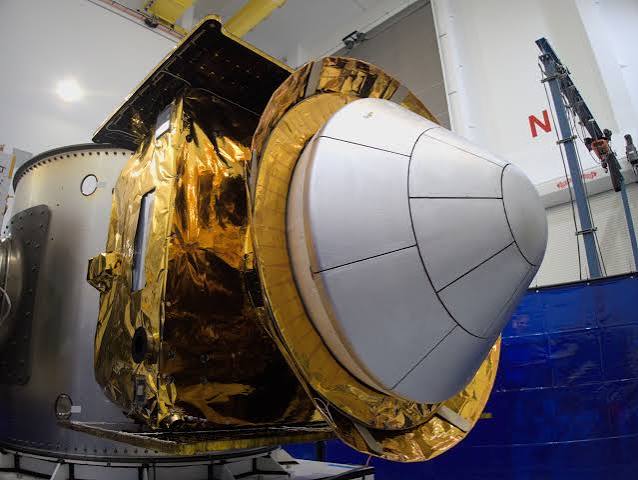
Varda Space builds small, uncrewed spacecraft that carry materials into orbit, process them in microgravity, and bring them back to Earth in a re-entry capsule. Its main target is pharmaceuticals: in microgravity, drug molecules can crystallise into different structures, which may make medicines more stable, more soluble or easier to deliver. Varda calls itself a life-sciences company that operates in orbit, and it builds its spacecraft, satellite bus and re-entry capsule in-house.
The company was founded by Will Bruey, a former SpaceX engineer, and Delian Asparouhov, a partner at Founders Fund. It flew its first mission in 2023 and has since completed six missions. In 2026 it had three vehicles in orbit at once for the first time, and it now runs a pharmaceutical laboratory at its El Segundo headquarters.
Its capsules return at hypersonic speed, meaning more than five times the speed of sound. That makes them useful to the US military for testing materials and sensors in conditions that are otherwise hard to recreate. Government testing currently supplies most of Varda’s payload business, while it builds partnerships with pharmaceutical companies for what it expects to be the larger, longer-term market.
On Earth, gravity drives several processes at once.
Particles with different density from the surrounding fluid rise or settle. Temperature differences create buoyancy, which drives natural convection. Hydrostatic pressure varies with depth. A free surface establishes a reliable up and down.
In an orbiting spacecraft, gravity is still strong. The vehicle and everything inside it are falling together, producing a low-acceleration environment. Residual acceleration remains from atmospheric drag, thruster firings, attitude-control motion, vibration, and rotating equipment, so “microgravity” is more accurate than “zero gravity.”
Without buoyancy-driven convection, heat and dissolved species move more through conduction and diffusion. Without sedimentation, suspended particles can remain distributed. Surface tension can dominate fluid shape and location.
These differences can matter for crystal growth. A crystal growing from solution creates concentration and temperature gradients near its surface. On Earth, convection and settling can disturb that boundary layer. In microgravity, slower diffusion-dominated transport may allow different crystal size, uniformity, polymorph, or defect structure.